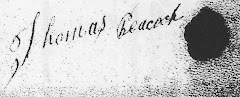
In the 1841 Scottish census, there is a Thomas Peacock living in Gorbals who could be our Thomas before he was married. The other surnames do not appear in the index for the 1831 census for Ballyrashane, but appear in the Coleraine area. The census was normally taken in the spring. Gorbals is a part of the city of Glasgow south of the Clyde River.
SCOTLAND 1841 Place: Gorbals -Lanarkshire Enumeration District: 13
Civil Parish: Gorbals Ecclesiastical Parish, Village or Island: Gorbals
Folio: 13 Page: 27 Address: Melville St (Source: Free Cen website)
Surname First name(s) Sex Age Occupation Where Born Remarks
MCCOOK Robert M 20 Cotton Hand Loom Weaver Ireland
MCCOOK Sarah F 24 Ireland
MCCOOK James M 1 Lanarkshire
MCCOOK William M 22 Labourer Ireland
MCCOOK Margaret F 22 Female Servant Ireland
ROBERTSON Robert M 22 Joiner Journeyman Ireland
MCCALASTER James M 20 Cotton Hand Loom Weaver Ireland
PEACOCK Thomas M 23 Labourer Ireland
The article below gives some background to why this could be possible.
(Taken from the following website: http://www.irish-genealogy-toolkit.com/Irish-emigration.html )
Irish immigration to Scotland: First half of 19th century
Irish immigration to Scotland was part of a well-established feature of early 19th century life in Ireland: the annual harvest migration. Since Scotland was Ireland's closest neighbour (only 13 miles separate the two countries at one point), it was an obvious choice for those that lived in the north of the island.
In the 1820s, up to 8,000 economic migrants crossed back and forth across the Irish Sea every year, bound for seasonal agricultural work or other temporary contractual work in northern England, Wales and Scotland. By the early 1840s, the number making the harvest migration alone had risen to about 25,000.
Permanent settlement usually required a greater skill base than agricultural labourers held. Most of the non-harvest migrants came with highly valued textiles and jute knowledge and came from the Irish counties where linen and yarn were produced – Derry, Donegal, Monaghan, Sligo and Tyrone.
These early trickles of Irish immigration to Scotland do not conform to the stereotypes of migration in later years which were largely about the arrival of unskilled and destitute people.
While most of the temporary migrants and probably a small proportion of the skilled workers eventually returned home to Ireland, some chose to settle permanently. This was more likely to happen in Scotland than in England or Wales, possibly because of the strong cultural ties between Scotland and Ulster, the province which provided most migrants to Scottish industries, especially in textiles.
Up to the 1830s, Scotland could offer if not rich pickings, at least a chance of a regular wage. The country was experiencing a boom in the construction of homes, factories, roads, canals and other infrastructure while the coal, textile and steel industries were also increasing production. Whole towns grew up to provide a workforce to some of these industries and saw the development of significant Irish communities within them. In Girvan, Ayrshire, for example, some three-quarters of the 6,000 population was Irish-born in 1831.
By 1841, when the earliest Scottish census was taken, some 125,321 (4.8%) of the 2.6million population was Ireland-born. In contrast, the Irish-born made up only 1.8% in England and just 0.78% in Wales.
Largest centres of Irish settlement:
(Irish-born as % of total pop) 1851
Dundee -18.9
Glasgow - 18.2
Paisley - 12.7
Kilmarnock - 12.1
The next decade saw the Great Famine exodus from Ireland when the poor and starving arrived in ports in desperate straits. By 1851, the Irish-born population of Scotland had reached 7.2%. The Irish were to be found in greater numbers in Glasgow, Dundee, in the mining communities of the Lothians and in Airdrie, Coatbridge and Motherwell.
These migrants came at a time when many Scots were emigrating to England, where wages were higher, or to more distant parts of the British Empire, looking for greater prosperity. As they left, they created work for the Irish, who went on to sustain Scotland's industrial revolution. They were especially famed as navvies building canals, bridges, railways and ports.


.jpg)